
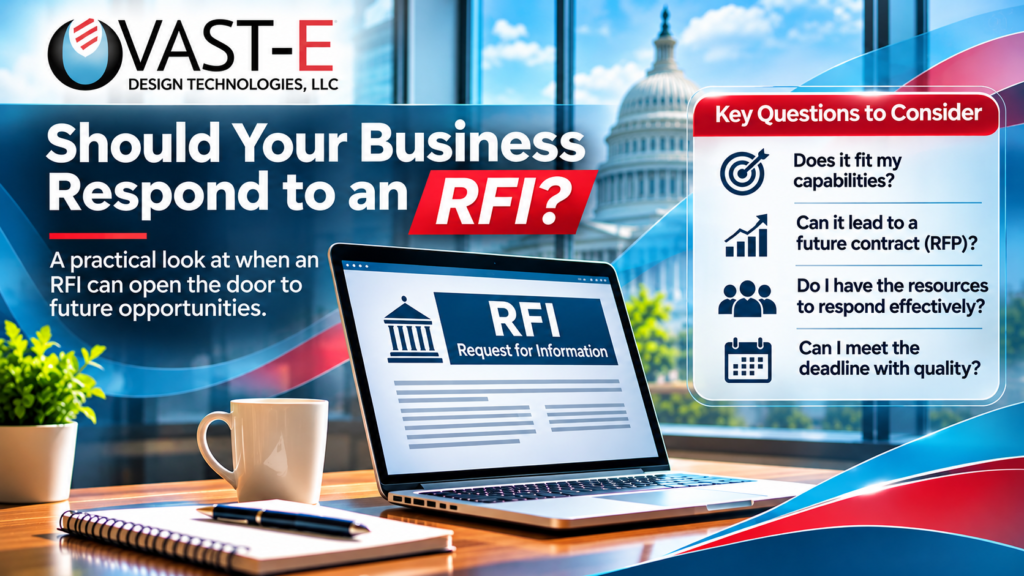
If your business is exploring government contracting, you may come across a Request for Information, commonly called an RFI.
At first glance, an RFI can be easy to ignore. There is usually no immediate contract award, and responding still takes time.
So is it worth it?
In many cases, yes — especially when the opportunity closely matches what your business can actually do.
What Is an RFI?
An RFI is generally used by a government agency to learn more about the marketplace before it moves further into the acquisition process.
Under the Federal Acquisition Regulation (FAR), agencies may use RFIs when they are not currently intending to award a contract, but want information about things such as industry capabilities, pricing, delivery, or other market conditions for planning purposes. An RFI response is not an offer and cannot itself create a binding government contract.
That distinction is important.
An RFI is usually less about “Give us your final proposal” and more about “Help us understand what the market can provide.”
The FAR also encourages communication between government and industry before proposals are received because those exchanges can help agencies better understand industry capabilities and allow businesses to better understand potential government requirements.
Your Response Can Help Shape What Comes Next
Government agencies are required to conduct market research in many acquisition situations. That research helps agencies determine what products or services are available and how the marketplace may be able to satisfy a government need.
GSA describes RFIs as one of the tools agencies use to gather business, technical, socioeconomic, and industry information during market research.
That means a thoughtful response can give an agency useful information about:
- What your company can provide
- How the work could realistically be performed
- Available technologies or approaches
- Industry practices
- Potential pricing considerations
- Challenges the agency may not have considered
- Whether qualified small businesses exist in the marketplace
You are not writing the solicitation for the government, but industry feedback can contribute to the agency’s understanding of the requirement before a final solicitation is released.
RFIs Can Be Particularly Important for Small Businesses
For smaller government contractors, responding to early market research can be especially valuable.
Federal contracting officials use market research to determine whether qualified small businesses are available. SBA guidance explains that agencies may use methods such as market surveys, small-business databases, and Sources Sought notices on SAM.gov to determine whether businesses are capable of performing the work.
An RFI and a Sources Sought notice are not exactly the same thing. GSA describes an RFI as primarily gathering information about supplier capabilities, while Sources Sought notices are often more directly focused on determining whether businesses can perform a particular requirement. Both, however, are market-research tools used in acquisition planning.
For a small company, that makes early-stage opportunities worth paying attention to.
If businesses that are capable of performing the work never respond, the government has less information showing that those capabilities exist in the marketplace.
But You Shouldn’t Respond to Every RFI
An RFI is still a business decision.
Before investing time in a response, ask:
Does this match our capabilities?
Can we realistically perform a meaningful part of the requirement?
Does this agency represent a market we want to pursue?
Could this lead to a future prime or subcontracting opportunity?
Can we provide useful information instead of simply sending a generic capability statement?
If most of those answers are yes, the RFI may deserve serious consideration.
If the requirement falls well outside your capabilities, responding simply to get your company’s name in front of the agency probably isn’t the best use of your time.
Don’t Treat an RFI Like a Sales Brochure
One of the biggest mistakes a business can make is responding with information that says very little beyond:
“We can do this. Here’s our company.”
Instead, read the RFI carefully and respond to what the agency actually asked.
Explain your relevant capabilities. Provide applicable experience. Address technical or operational questions. Identify concerns when appropriate. Offer constructive recommendations when the agency specifically requests industry feedback.
GSA’s market-research program emphasizes that agencies rely on industry partners to provide timely and relevant information through RFI responses.
Your response should help the government understand the market — while also demonstrating that your company understands the problem.
Think Beyond the Immediate Opportunity
An RFI may not produce a contract tomorrow.
That doesn’t necessarily mean responding was wasted effort.
For a company building its government-contracting presence, an RFI can help you research an agency, understand upcoming requirements, sharpen your capability messaging, identify potential partners, and become more familiar with how government buyers describe their needs.
It can also prepare you to make a much better Go / No-Go decision if an RFP or RFQ eventually follows.
So, Should You Respond?
The answer shouldn’t automatically be yes.
But it shouldn’t automatically be no just because there is no immediate contract attached.
When an RFI aligns with your capabilities and target market, responding can be a relatively early opportunity to participate in the acquisition process and help the government understand what businesses like yours can provide.
At VAST-E Design Technologies, we look at RFIs as more than documents to answer. They are opportunities to evaluate the requirement, understand the customer, assess our capabilities, and determine whether a potential opportunity fits the direction of the business.
Sometimes the right decision is to respond.
Sometimes the right decision is to pass.
The important part is knowing why.
Sources
Federal Acquisition Regulation — FAR 15.201, Exchanges with Industry Before Receipt of Proposals. Defines the purpose of pre-solicitation industry exchanges and explains how RFIs may be used. FAR 15.201 — Acquisition.gov
Federal Acquisition Regulation — FAR Part 10, Market Research. Covers federal agency market-research requirements. FAR Part 10 — Acquisition.gov
U.S. General Services Administration — Market Research as a Service. Explains how GSA uses RFIs and other market-research methods to collect information from industry. GSA Market Research as a Service
U.S. Small Business Administration — Guidance for Federal Contracting Officials. Explains how agencies research the availability and capabilities of small businesses when planning acquisitions. SBA Guidance for Federal Contracting Officials